
Nicholas P. Money
A Is for Amoeba: The Story of Life in a Single Cell
We encounter many oddities in the world of amoebas, none stranger than the giant marine amoebas that sit on the seafloor in the deepest parts of the oceans and look like cauliflowers. These are the organisms that I call sea scrunchies because they accumulate masses of gravel to form an exterior skeleton. They are among the largest single-celled organisms, but we don’t know a lot about these creatures because they fall apart when we dredge them from the abyss.
We know much more about the shelled amoebas that live in ponds, which have become my favorite microorganisms. Some of these amoebas manufacture plates of silica and protein inside their cells and organize them in beautiful patterns on their surfaces. Others sort through rubble in the pond sediment and use their pseudopodia to arrange particles of sand and broken diatom husks like puzzle pieces. When the shells are complete, the amoeba sits inside and extends its pseudopodia to grab food like an octopus from a jar on a shipwreck. The shells provide protection for the amoeba and also work like miniature diving bells, weighting the cells, keeping them in place on plant leaves so that they are not swept away by water currents.
It is worth underscoring the mind-bending complexity of the shell-building amoebas: these are single cells with no nervous system that carry out the ordered assembly of individual particles according to size and shape so that they fit together without any gaps. They secure the pieces with glue and complete the task in less than an hour. We have no idea how the amoeba does this, how it measures the size of each particle, how it determines when it is in the correct position, how it infers when the job is completed.
Investigators have tried to emulate the computations that must be embedded in the DNA and cell structure of amoebas in the design of software programs, liquid metal robots, and analog computers, but none come close to the sophistication of the living cells. As I write at the end of the book: “We can eye the amoeba, poke it with needles, catalog its parts, and read its genes, but our understanding of cell biology still falls short of explaining how such a divine thing works. We sit brooding on the wrong side of the abyss. Meanwhile, emptying itself from here to there, the amoeba explores its corner of Eden with little control over what happens next. Almost like us.”
Broad observations from A Is for Amoeba
(i) The genome of Amoeba proteus is much larger than the human genome. The impression of genetic overengineering in the amoeba disappears when we recognize that cells are complex machines whether they live on their own or inside an organism made from trillions of them. While there is a lot more to a human being than an amoeba, there is no more to being a cell in a human than being the cell of an amoeba.
(ii) Amoebas highlight the downside of having a brain. Amoebas show many expressions of awareness and agency when they move around obstacles, chase their prey, and evade their predators. The more we learn about amoebas, the smarter they seem. As their membranes flow and flinch we begin to see the evolutionary groundwork for all of our emotions, from delight to desperation and the rest of the monkey chatter between our ears. Amoebas are motivated by their inner state, responding to hunger for example, but we do not imagine that they have any capacity for self-reflection. An amoeba can react to internal signals that it is running out of energy but cannot think “I am hungry.” This mental sophistication requires a brain, which evolved in parallel with the experience of pain and suffering. Amoebas are blissfully ignorant, whereas animal life is a nightmare.
(iii) The behavioral sophistication of amoebas is apparent from the degree of unpredictability to their movements, with the cell flowing one way for a few seconds before extending another pseudopodium in a constant search for the optimal conditions. Amoebas are adventurous but wary, goal-oriented and sometimes impulsive, they show how life is chaos making sense of chaos.
Curator: Bora Pajo
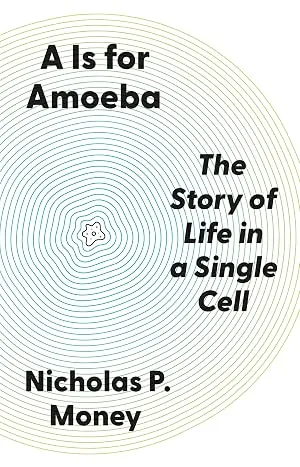
A Is for Amoeba: The Story of Life in a Single Cell
Money, N. P. (2026). A is for amoeba: The story of life in a single cell. Princeton University Press.
Available here →November 13, 2026
20261113-money-a-is-for-amoeba-a-close-up
A close-up
The rest of this thread

© Gia Mariani
Nicholas P. Money
Nicholas P. Money is professor of biology at Miami University in Ohio and the author of many books, including Molds, Mushrooms, and Medicines: Our Lifelong Relationship with Fungi, The Rise of Yeast: How the Sugar Fungus Shaped Civilization, and Mushrooms: A Natural and Cultural History. He also wrote the Very Short Introductions to Microbiology and to Fungi for Oxford University Press. Beyond his scientific interests, Nicholas Money is infatuated with the poetry of John Milton.
Pull this thread
There is no more to being a cell in a human than to being the cell of an amoeba.
More in Books
Know something the rest of us don't?
Most threads on Rorotoko begin with our invitation. Any thread can begin with a proposal: you write it with the same prompts every thread answers, and we review it.
Propose a thread →