
Nicholas P. Money
A Is for Amoeba: The Story of Life in a Single Cell
I am a mycologist and my attention to amoebas is a late career discursion. My gateway to these microorganisms was the growing interest in the phenomenon of cellular consciousness in a variety of single-celled protists, which I suggested should be extended to studies on fungi. Intrigued by studies on conditioned or Pavlovian behavior in amoebas, I wanted to learn everything about them, or as much as I could by reading and looking at wild amoebas collected from ponds. So, that’s how this started. The star of my book is Amoeba proteus, the familiar species featured in biology textbooks, but there are thousands of other species of single-celled organisms that move in the same way. Fluid amoeboid movements are spread across the entire tree of life and there are some real surprises among these shape-changing species including vampire amoebas that turn red as they suck the juices from algae, amoebas that assemble beautiful shells using fragments of sand, and amoebas that hunt in packs to capture worms.
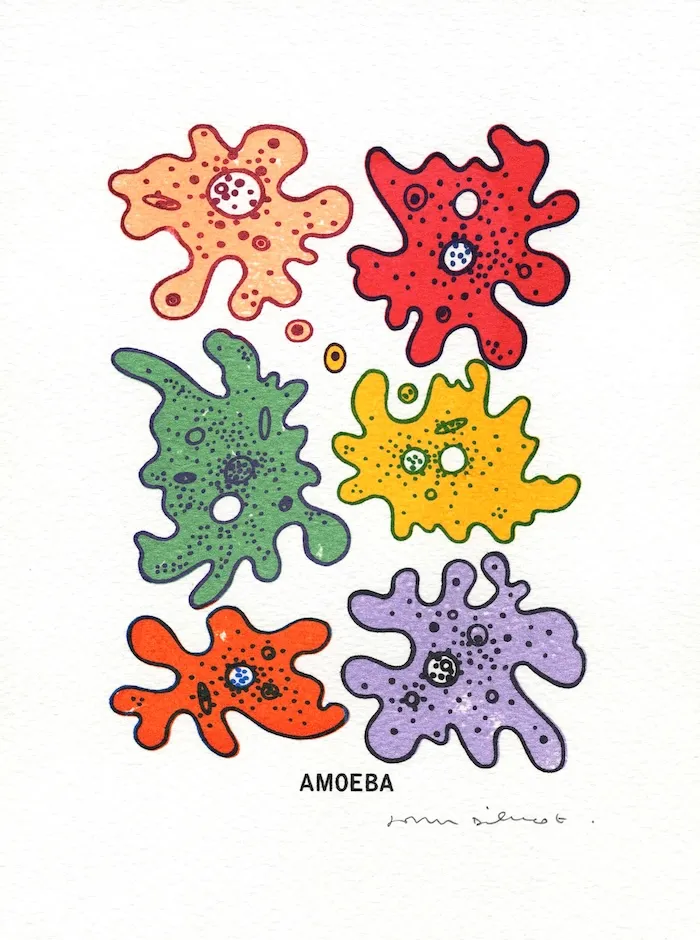
As my inquiries deepened, I also learned about the disease-causing or pathogenic amoebas in lakes and rivers, which can also thrive in drinking water. The worst infections are caused by a handful of amoeba species when they are snorted into the nasal cavities and crawl into the brain. Infections with these lethal brain-eating amoebas are very rare, although there is concern that they are becoming more widespread in response to climate change.
The amoeboid cells that fill our bodies are also featured in my book. These are the hundreds of billions of white blood cells that circulate through our bodies, gobbling bacteria throughout our lives. Intus me repent, ergo sum: they crawl inside me, therefore I am. Unfortunately, cells that become cancerous by evading the immune system also use an amoeboid form of movement to spread between tissues. Human amoebas good and bad are part and parcel of life and death.
Ongoing thread. More from Nicholas P. Money to follow.
Curator: Bora Pajo
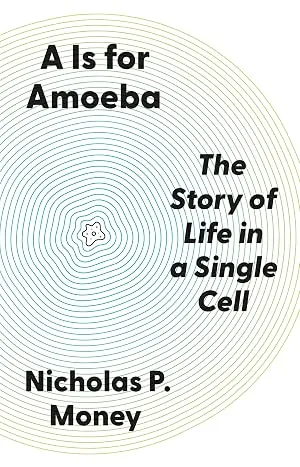
A Is for Amoeba: The Story of Life in a Single Cell
Money, N. P. (2026). A is for amoeba: The story of life in a single cell. Princeton University Press.
Available here →October 25, 2026
20261025-money-a-is-for-amoeba-the-wide-angle
The wide angle
The rest of this thread

© Gia Mariani
Nicholas P. Money
Nicholas P. Money is professor of biology at Miami University in Ohio and the author of many books, including Molds, Mushrooms, and Medicines: Our Lifelong Relationship with Fungi, The Rise of Yeast: How the Sugar Fungus Shaped Civilization, and Mushrooms: A Natural and Cultural History. He also wrote the Very Short Introductions to Microbiology and to Fungi for Oxford University Press. Beyond his scientific interests, Nicholas Money is infatuated with the poetry of John Milton.
Pull this thread
There is no more to being a cell in a human than to being the cell of an amoeba.
Know something the rest of us don't?
Most threads on Rorotoko begin with our invitation. Any thread can begin with a proposal: you write it with the same prompts every thread answers, and we review it.
Propose a thread →