
Miriam Rasch
Listening
How can we understand listening as an ethics? In my book, I approach listening as a relation that is mediated by technology. When you listen, you’re listening to someone or something. There’s a movement of reaching outward. It connects me to you. Or to others, nature, music, the world.
Technologies often mediate this relationship. Obviously, a technology like the phone has had a huge impact on what we can hear and how we listen. And then there’s social media. Social media lets us hear many different voices. But how is the relationship mediated? Listening takes the form of scrolling, endlessly moving to the next thing. The focus is on consuming, amplifying, confirming. Even your attention is turned into a mode of sending, when you viewing something brings it higher up in the algorithmic feed.
So, what could we call ‘good listening’? Listening works with the opposing forces of attention and receptivity. Focus, which is directed outward and being open and welcoming, which is directed inward. For attention and receptivity to make a certain relationship possible, they need time and space, sensibility, and practice – things that our technology doesn’t encourage. It’s not easy, but we have the tools available to us. And while it’s mostly quiet, it makes things happen. Because just speaking, without the words ending up somewhere, mostly designates a void. Listening is a ‘maieutic’ practice: it allows the words of the other to get birthed. And this makes it an ethical practice as well.
The book recounts a philosophical journey into an ethics of listening, but it’s equally the result of doing a lot of very practical and embodied research. I didn’t want to just talk about listening without putting it into practice. Ethics is all about ‘what to do’ – in real life and with other people. And listening as act involves something ‘out there’, so that should be part of the investigation.
That started right at the beginning, back in January 2021. We were in lockdown because of the pandemic. Working from home and hardly seeing anyone, I gave myself a New Year’s challenge. I asked everyone around me (mostly online) to give me tips and advice about ‘ethics and listening’. And I noted down everything that came back. People shared lots of names, sources, articles, ideas, and random thoughts with me. Even long after. In the end, it took me to loads of different places, like debates, lectures, museums, and concerts. I tried out deep listening sessions and singing bowl healings, I did sound recordings, playing music, and had deep, loving, and disturbing conversations.
The book weaves all these strands together in four long essays. One of the biggest challenges was keeping my focus on the theme of listening all the time. It’s interesting that a lot of the research into listening is actually about speaking. For example, it might be about how to ask good questions or how to formulate a good argument. Speaking is so dominant, that I found it quite difficult to keep myself on track all the time. But that taught me the most important of lessons, because this is precisely why listening itself is also difficult. It asks for our concentration and attention and for us to let go of your own voice. And that’s not something that is stimulated by our surroundings these days, which always seem to be competing for our attention and making us feel like we need to be heard all the time.
Ongoing thread. More from Miriam Rasch to follow.
Curator: Bora Pajo
November 12, 2026
20261112-rasch-listening-the-wide-angle
The wide angle
The rest of this thread

© Daan Beeke
Miriam Rasch
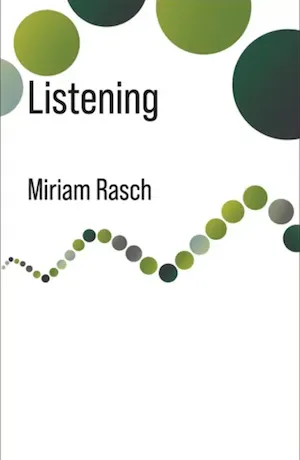
Miriam Rasch is a philosopher and essayist who writes about literature, ethics, technology, and life in post-digital times. She writes for different media outlets and works as a research educator and coordinator for the Willem de Kooning Academy in Rotterdam, The Netherlands. Her book Listening is published by Columbia University Press in September 2026.
Pull this thread
Listening is an active, unsettling act, and the forgotten counterweight to a culture of seeing and speaking.
More in Books
Know something the rest of us don't?
Most threads on Rorotoko begin with our invitation. Any thread can begin with a proposal: you write it with the same prompts every thread answers, and we review it.
Propose a thread →