
Rescue
A very powerful woman's story
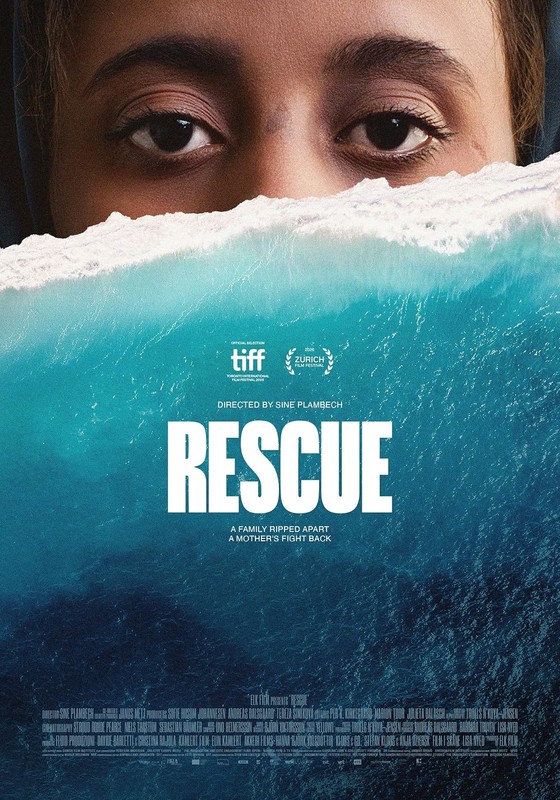
The film is called Rescue because Roro rescues her baby. It's not so much about a rescue ship rescuing migrants and refugees. It's about a mother rescuing herself and her children, and her striving for justice after she comes to Germany.
In the film, I follow the Doctors Without Borders rescue ship for about a year on the Mediterranean, to focus both on the political situation there and on the human stories of the people who are rescued at sea. That was my idea from the get-go: to see how I could combine the political with the human story. But when you film at sea with a rescue ship, you don't know who is going to be rescued. People are migrating, and are refugees, from so many countries these years. So I had to be open to the fact that it could be anyone who came on board, while knowing that I needed my anthropological analysis and the perspective of these two levels, the more global and the more intimate.
When we were filming at sea, we witnessed and documented the kidnapping of 25 women and 4 children by a Libyan militia. The militia took the women and children back to Libya. They shot at the men, and the men jumped into the water and were rescued by Doctors Without Borders.
So in the film I follow one of the husbands, Hani, whose wife was kidnapped. Over the months that follow, I follow his life in Italy and in Germany where he applies for asylum. It is the story of the young mother, his wife Roro, who was fighting for herself and her children while being held captive in Libya.
It's a story about why such a kidnapping happened at all. What is going on in the Mediterranean, so that a Libyan militia can kidnap refugee women in front of my camera? But also: how did it feel to be her? What did she endure? It's maybe a plot spoiler, but the film ends with them being reunited in Germany, after seven attempts to cross the sea, and sexual exploitation, and many things that happened to her. So it's a story about the consequences of the political for this little family, and about how she is trying to rescue herself.
The kidnapping is not allowed. But during what we call the first European refugee crisis, let's say ten years ago, during the war in Syria, the European countries had a common, shared rescue flotilla to rescue people crossing the sea. So many people were crossing that they decided: no, we are going to stop them on the North African coast instead. They shouldn't risk their lives to come to Europe. That was how they legitimized it, that it was actually to rescue the people themselves. So they would send money to Libya, to Tunisia, to North African countries, and have their border guards and coast guards stop people.
But when you send billions of euros to a country like Libya, which is already in conflict, with a lot of militias and two governments, only one of them recognized by the UN, you don't always know where the money ends up. What we have seen is that a lot of this money from the EU circulates among legal and illegal entities, among them a lot of militias, who make a lot of money sailing out to sea and kidnapping people back. Then selling them again, back and forth, in an endless system of ransom, of buying and selling people, which exploded when Europe started to send money to Libya.
So when you ask how the kidnapping could happen, it is because of these larger political structures that have nothing to do with Hani and Roro, but which ended up influencing their lives in such a deep way.
Ongoing thread. More from Sine Plambech to follow.

Bicycle Thieves
It is remarkable how World War Two continues to loom so large in our mid-21st century geopolitics and in our cultural imaginations, even more than 80 years after it ended. But one of the most fascinating cultural turns of the last generation or so in both historiography and cultural memory has been a shift of focus onto the aftermath of that war as a distinct, foundational moment in world history in its own right. Europe, the West, empires and their disarticulation, dictatorships and their collapse, new global binaries thrown up by the Cold War, new forms of utopian internationalism and dystopian degradation: all were potently shaped by the specifics of the postwar, by the devastation of war itself and the upside-down and opened-up world it left behind. Tony Judt’s magisterial account, entitled precisely Postwar, published in 1995, can stand as an emblematic marker of this turn to the aftermath.
Culture, too, had its postwar moment, a moment of crisis and renewal that rushed in to fill the void left by the end-times and the new beginnings of the late 1940s, offering ways to capture a world in transition, the new that was waiting to be born, and with it new subjects and objects of expression, new stories. At its very widest, then, my micro-study of one film from 1948 belongs to this turn to the postwar. Paying close attention to Bicycle Thieves, both under its conventional label as a neorealist classic – neorealism was one much-celebrated symptom of that postwar cultural explosion – and against its simplistic labelling as a classic, is one way to tap into the lives and landscapes, the lived experience of this uncertain historical moment.
In this sense, I argue in the book, Bicycle Thieves deliberately occludes the war in a way that was somewhat unusual for the time, but it remains there as an undertow that conditions the social, economic and existential realities of postwar Rome that the film depicts. Why is our hero Antonio unemployed? Why do he and his wife Maria have one infant only a few months old and one 8- or 9-year-old son, Bruno, and what histories did these parents see and live through between their two births? What has drained Antonio of his drive, his life-force, his dignity as a worker, father and husband, his happiness? De Sica’s film very deliberately leaves these ‘origin’ questions unanswered (the answers would be Fascism, the war, occupation, we might surmise). In doing so, the subject of the film’s tragedy and melodrama becomes the ‘here and now’ of the postwar, subtly shadowed by the dark heart of 20th-century history that preceded it.
Ongoing thread. More from Robert S. C. Gordon to follow.
This week's threads
All the threads →



The Age of Irreverence
Know something the rest of us don't?
Most threads on Rorotoko begin with our invitation. Any thread can begin with a proposal: you write it with the same prompts every thread answers, and we review it.
Propose a thread →