
Susana Carmona
A Mother’s Brain: The New Science of the Neuro-Maternal Revolution
Every mother knows that motherhood marks a before and an after in the story of her life. What this book shows is that this transformation also happens in the brain. During pregnancy, a woman's brain changes enormously. It changes even more — or at least faster — than it did during adolescence. These brain changes are so pronounced that today, from neuroscience, pregnancy and the postpartum are considered one of the most plastic periods of adult life. Let's remember that plasticity is the brain's capacity to adapt in response to internal or external demands.
Recent neuroimaging studies show that, during pregnancy and the postpartum, the brain remodels regions involved in social cognition, empathy, the sense of self, motivation, and even regions that govern our most basic impulses. Some of these changes are orchestrated by the hormones of pregnancy; others by the interaction with the little ones. Taken together, these brain adaptations appear to promote the mother's well-being and her bonding with the baby. And while some of the changes revert within the first months after birth, others seem to last a lifetime.
It matters that motherhood be studied through a scientific lens, and not through anecdote or opinion. In Spain we have a saying: "Cuando no hay dato, hay relato" — roughly, "where there's no data, there's a story." And until relatively recently, motherhood has been full of stories and built on very little data. Those stories painted the process through three main lenses, all clearly distorted. Idealization: it's all instinct and bliss. Minimization: nothing has happened, go back to your old self as fast as you can. And denigration: the famous "mommy brain," the idea that the moment you become a mother, your cognitive abilities decline.
The book dismantles all three, with evidence from psychological and neuroimaging studies.
Let's start with idealization. As we've said, the peripartum is one of the most plastic moments of adult life. But a plastic brain is also a vulnerable brain. It's the other side of the coin. A brain that changes this fast and this deeply is also, for a time, more exposed: like clay on the potter's wheel, the very softness that lets it take a new shape is what can damage it. And we see that vulnerability in the epidemiological data. Roughly one in five women experiences perinatal depression, and in developed countries suicide linked to peripartum mental disorders is one of the leading causes of maternal mortality. Motherhood can be wonderful — but not always, and not for every woman. It isn't the idyllic moment we were sold; pretending it is only leaves many mothers blaming themselves in silence, too afraid and ashamed to ask for help.
Now to minimization. The changes of pregnancy resemble, in some ways, those of adolescence. That's why we speak of matrescence — a term the medical anthropologist Dana Raphael coined in the 1970s, by analogy with adolescence, to name the process of becoming a mother. Both come with a great hormonal storm, with moments of emotional ambivalence that push you to lose yourself in order to find yourself again, to redefine yourself across several areas of your life. Just as no one would dream of asking an adolescent to go back to being the child she was, it makes no sense to pressure a mother to return, as quickly as possible, to who she was before.
And we come to denigration — the supposedly lost cognitive abilities. What's true about "mommy brain"? Some mothers feel their memory and attention aren't what they used to be. This calls for a deeper look, rather than settling for the mommy-brain quip. It's important to realize that gestating, giving birth, and breastfeeding are not trivial processes. They are as metabolically demanding as running a marathon. Add to that the sleep deprivation that so often comes with the postpartum. Anyone in that state — whether a mother or a top executive — will take a cognitive hit. What's more, during the postpartum, the signals coming from the baby have the power to hijack our attentional resources. That doesn't mean we have less attention or memory; it means they're redistributed toward whatever our body and brain flag as most relevant to our well-being in that moment. Another important point is that caregiving carries an enormous mental load — one that should be shared between both parents, but that, unfortunately, still tends to fall on the mother's side. Monitoring the feeds, naps, doctor's appointments, schedules, and a long et cetera. A load that's rarely named and rarely valued — but that is always there, quietly consuming resources. Here's the good news: the intensity fades. This peak is concentrated in the earliest stretch, and as the children grow and the daily demands loosen, what's left is a brain that has been thoroughly put through its paces. Over the long run, in fact, women and men who have raised children tend to do better on cognitive tests — and their brains show fewer signs of aging. Being a parent is like doing sudokus, constantly. It’s not just cognitive training. Along the way we pick up a handful of skills that matter far more — in life and at work — than any memory test. We learn to regulate our own emotions, to plan, to squeeze the most out of scraps of time, to improvise when the plan falls apart, to sit with frustration, to negotiate, to pull together as a team and a long etcetera. Someone once told me that becoming a parent is like earning a master's degree in humanity, and I think he nailed it.
Ongoing thread. More from Susana Carmona to follow.
Curator: Bora Pajo
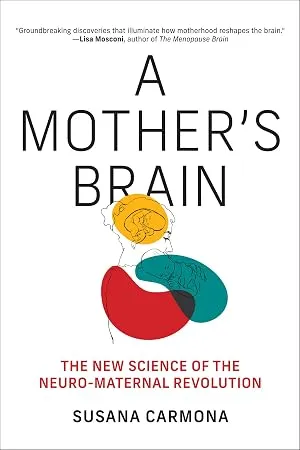
A Mother’s Brain: The New Science of the Neuro-Maternal Revolution
Carmona, S. (2026). A mother's brain: The new science of the neuro-maternal revolution. MIT Press.
Available here →November 5, 2026
20261105-carmona-a-mothers-brain-in-a-nutshell
In a nutshell
The rest of this thread

Susana Carmona
Susana Carmona is a neuroscientist and directs Neuromaternal, the neuroimaging group at the Instituto de Investigación Sanitaria Gregorio Marañón in Madrid, a pioneer in studying how pregnancy and motherhood transform the human brain. A psychologist by training with a PhD in neuroscience, she studied at the Universitat Autònoma de Barcelona, Columbia University, and Harvard. She has published more than sixty scientific articles, some in journals such as Nature Neuroscience, and co-leads the pregnancy and parenthood groups at ENIGMA-Neuroendocrinology and the Ann S. Bowers Women's Brain Health Initiative. She is the author of A Mother's Brain (MIT Press).
Pull this thread
Pregnancy remodels a woman's brain faster than adolescence did.
More in Books
Know something the rest of us don't?
Most threads on Rorotoko begin with our invitation. Any thread can begin with a proposal: you write it with the same prompts every thread answers, and we review it.
Propose a thread →