
Nathan Wainstein
Bad Writing in the Modernist Novel
In my first fall of grad school, I took a course on the Gothic novel. One of the books we read was Mary Shelley's Frankenstein. Maybe the most famous moment in the entire novel is when Victor Frankenstein animates his creature. I wrote a paper about how that moment, in terms of its narrative perspective, its storytelling, is very, very weird. It almost doesn't make sense. Space is operating in a very strange way, so that it's very hard to understand where the laboratory is in relationship to the bedroom. It's kind of like that meme about Seinfeld's apartment: it doesn't actually make sense if you try to piece it together. And Victor Frankenstein himself behaves extremely strangely. He doesn't seem to be acting realistically, but not in a way that feels gothic.
So I wrote my paper about all of these strange narrative distortions, as I call them. The professor read the paper and said, you know, this is interesting, this is a good example of close reading, but Shelley was only a teenager when she wrote Frankenstein. For me, that was a really eye-opening moment, because she said very clearly and simply something that I'd recognized but hadn't articulated: the very same deviant narrative phenomena that I found so exciting as a critic could also be, from another angle, just mistakes, or instances of sloppy or untrained writing. I thought that was interesting, but I moved on. I figured, okay, that was just her objection, but I don't need to change how I work.
Years later, when I was preparing for my dissertation, before I had settled on this topic, I was working on a different dissertation, also about deviations in narrative. As I was reading novel after novel after novel in preparation for my orals exam, I found myself again and again most excited when novels seemed to be breaking rules. If I read an episode in a story and thought, wait a minute, this actually contradicts something that was said earlier, and the novel never addresses it, I would get really excited. Or if a narrator tells us there's a room here and a room here, but if you try to put them together logically they don't make sense, I would get really excited. And when the novel was just behaving well, when the writing was really good, I might say, that's a beautiful sentence, that's a beautiful chapter, but I wouldn't get excited. I would just be like, all right, this novel is working.
So at one point I had this crisis of confidence: why do I care? Why do I want my novels to fail, to not function the way that a novel seemingly should function? And I got very empirically, practically interested in that question. I started thinking back through my training, through the various influences, intentional and environmental, that had taught me to look for those moments where things aren't working. Ultimately, I decided that what I would like to do in my dissertation, which became my book, was put some pressure on that instinctual gravitation toward moments of rule breaking. That's when I remembered my professor in my first year, and I thought, well, maybe bad writing is actually the concept that we need. Maybe literary criticism lacks an understanding of bad writing, despite being powerfully drawn to moments that could be bad writing, and that a non-specialist might say could be bad writing.
“Bad” is an incredibly loose term, and there are a lot of different ways, maybe infinite ways, that art can be bad. I'm interested specifically in the breaking of rules. Even today you'll find critics, and especially artists, making negative judgments about modernist novels, but what they think is bad is actually the opposite: moments that feel too rule-bound, too conventional, too cliché.
I also think there's a difference between the kind of pleasures we take in life and the kind of pleasures that we admit to in academic criticism. In fact, one could say that when literary critics are writing elaborate interpretations of sentences that don't make sense in novels, they're actually taking immense pleasure in the exercise of critical ingenuity to make this moment seem good or interesting. My book is interested in that, too, partly because I feel very acutely the pleasure of writing that these moments can engender.
The French theorist Roland Barthes has this dictum that ugliness can be described, but beauty cannot, because beauty just repeats itself. All you can say is, “that is beautiful”. So beauty is tautological. I do think there's something true about that when it comes to art, too. When something is formally or stylistically ugly, you can write and write and write to pinpoint why it's bad, but if something's really beautiful, what do you say? You just go, “that's beautiful”. So there's a practical element to this: rule breaking is actually really good fuel for critical writing. And I don't think that's a problem. I just think we need to acknowledge it, and be more honest about it.
Ongoing thread. More from Nathan Wainstein to follow.
Curator: Bora Pajo
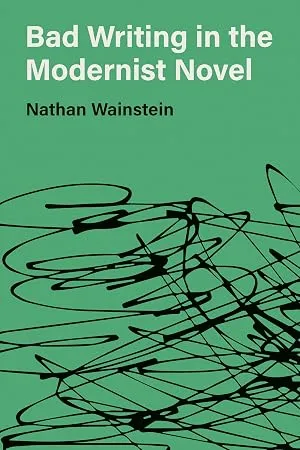
Bad Writing in the Modernist Novel
Wainstein, N. (2026). Bad writing in the modernist novel. Johns Hopkins University Press.
Available here →November 4, 2026
20261104-wainstein-bad-writing-in-the-modernist-novel-the-wide-angle
The wide angle
The rest of this thread

© Lisa Winner Photography
Nathan Wainstein
Nathan Wainstein is Assistant Professor of English at the University of Utah. He is the author of Bad Writing in the Modernist Novel (JHUP, 2026) and Grant Us Eyes: The Art of Paradox in Bloodborne (Tune and Fairweather, 2025). His work has appeared in Representations, Novel: A Forum on Fiction, Textual Practice, and LARB, among other venues. He hosts the podcast Authors Die Twice with Bryan Counter.
Pull this thread
Critics prize broken rules in modernist novels and refuse to admit that some are simply mistakes.
Know something the rest of us don't?
Most threads on Rorotoko begin with our invitation. Any thread can begin with a proposal: you write it with the same prompts every thread answers, and we review it.
Propose a thread →