
Annebella Pollen
Snap Happy! How Children Became Photographers
The radical disruptions of student uprisings and women’s liberation movements in Britain in the late 1960s flowered in the early 1970s into new campaigns for children’s liberation. Their promoters mobilised alternative forms to support children’s autonomy, from free schools with self-directed curricula to adventure playgrounds where kids built their own apparatus. Alongside, new publications emerged. Children’s Rights, established 1971, had teachers, psychiatrists and children’s authors as editors, children as contributors, and truly radical demands. Its core premise was that children are autonomous beings, with independent needs, desires and opinions, and a right to self-govern.
The Children’s Rights Workshop, founded in 1973, ‘was set up to reaffirm the fundamental fact that children are people’. Its organisers stated, ‘Children are not automatically “underdeveloped”, “immature”, “incapable”, “irresponsible” or “ignorant”.’ New visual models were needed to represent children; visual stereotyping was central to their oppression. ‘Children are not objects of “consumption”, fodder for people with film in their camera, nor can they be reduced merely to shades of grey or an amalgam of lines and light’, they argued. Photography ‘perpetuates these images to which children are particularly vulnerable’. One method to right the wrongs was to guide children in camera use to inspire them to shoot back.
Jo Spence, in 1973 a disillusioned high street portrait photographer, was involved in the Children’s Rights Workshop as part of her wider interest in using photography as an ideological tool to create radical alternatives. There she met Terry Dennett, who ran the photographic department of London Zoo’s research institute as his day job and, since 1971, who taught children photography in the evenings in South Island Place in Lambeth, south London.
As lovers and as collaborators, with a shared interest in demystifying photography and empowering communities to represent themselves, Spence and Dennett encouraged children of diverse ages, sizes, ethnicities and abilities to take photos using a 35mm film camera, a 1910 plate camera and pinhole devices built from prams and chocolate tins. Old boots and toys were lined with light-sensitive paper and reconfigured using lenses made from front door peepholes. They were playfully named, after the famous Rolleiflex camera, the Wellie-flex and the Dolly-Flex. Dennett stated: ‘We are getting kids to make things out of nothing, taking ordinary things, breaking them up and recreating them into something which is their own.’
Younger children painted with developer on photographic paper. Camera-less sun-print photograms were populated with children’s hands, toys and roadside weeds. Throughout there was a questioning of authority. Children were guided to take photos of signs that told them what and what not to do, and they were schooled in cut-up as a method for deconstructing normative media messages about sex roles. Their felt-tip and coloured pencil interventions on prints were expressive and subversive. Left to their own devices, doodling children might draw glasses or beards on faces in magazines. To do so on a photo of local police officers was a different premise and a small gesture of power. ‘People they like they might colour in a certain way’, Dennett said of this method; ‘people they hate, they might gouge the eyes out or something. For group dynamics, this is really useful information.’
Children were encouraged to take documentary-style photos of where they lived, and this included inner city tower blocks without a blade of grass in sight. They photographed local labour, including women working on market stalls and a wig shop, and they pictured one another pulling pin-up or bodybuilder poses in streets and parks. Photos were developed by children in improvised darkrooms constructed from clothes horses or plastic carrier bags.
The South Island workshops served 180 children aged 5-17. Only two had used a camera before and none had darkroom experience. Children were given instruction but a lot of freedom. Darkroom developing comes with risks – children were asked not to eat the chemicals – but there was striking faith in their capacities, and the older helped the younger. These approaches supported self-reliance and independence, especially from the photographic industry, whose visual norms were perceived to set limits that should be disrupted. ‘If’, Dennett said, ‘kids can do that in photography, they can do it socially, politically and in many other ways.’
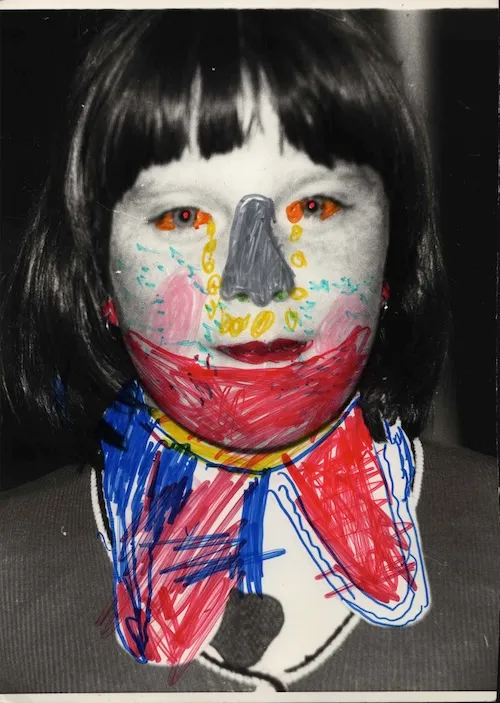
Uncredited embellished photograph produced by children in the South Island Photography Workshop, 1970s. Terry Dennett collections, courtesy of MayDay Rooms.
Curator: Bora Pajo
Snap Happy! How Children Became Photographers
Available here →October 27, 2026
20261027-pollen-snap-happy-a-close-up
A close-up
The rest of this thread

Annebella Pollen
Annebella Pollen is Professor of Visual and Material Culture at University of Brighton, UK, where she researched undervalued archives and untold stories in art and design history. She has written six books: Mass Photography: Collected Histories of Everyday Life (2015); The Kindred of the Kibbo Kift: Intellectual Barbarians (2015); Nudism in a Cold Climate: The Visual Culture of Naturists in Mid-20th Century Britain (2021); More Than a Snapshot: A Visual History of Photo Wallets (2023); Art Without Frontiers: The Story of the British Council, Visual Art, and a Changing World (2024) and Whippersnappers: How Children Became Photographers (2026).
Pull this thread
For a century, children with cameras have ignored what teachers, clubs and Kodak told them to photograph.
Know something the rest of us don't?
Most threads on Rorotoko begin with our invitation. Any thread can begin with a proposal: you write it with the same prompts every thread answers, and we review it.
Propose a thread →