
Evan Chaloupka
Engaging Minds: Cognitive Disability and American Storytelling, 1899–1953
In disability fiction, distance lends us not only drama, but intimacy.
From the Netflix drama Atypical to the Japanese manga-turned-anime Komi Can’t Communicate, our world today is awash with representations of minds that think, feel, and perceive differently. This rich present makes for an ideal time to reconsider the literary history of mental difference. Whatever the achievements of contemporary storytellers may be, twentieth-century American writers approach the disabled mind in ways worth remembering. My book, Engaging Minds: Cognitive Disability and American Storytelling, 1899-1953, holds that this tradition involves a certain politics of representation to be sure. But more than just representation, I consider how writers draw readers into relation with disability using specific storytelling features, including narration, vision, and time among others.
The relationships authors cultivate grow out of unique, and often underappreciated, coordinates of intimacy and distance. Authors use the most foundational feature of fiction – i.e., the turning of a page – to adjust these coordinates as a story progresses. Thinking about disability narrative in this progressive way requires our acknowledgment that authors might open up unique paths of access to disability at times only to withhold them at others. It challenges us to remember that intimacy does not necessarily mean uninterrupted access to an unbroken flow of subjective, interior thought. Moments of direct access interspersed by less-direct but equally moving moments of curiosity, longing, or the acknowledgement of separation can be just as aesthetically and ethically compelling.
Some of the works I survey will come as no surprise to readers: William Faulkner’s The Sound and the Fury, John Steinbeck’s Of Mice and Men, and Pearl S. Buck’s The Child Who Never Grew. But other works might, like Frank Norris’s McTeague, Jean Toomer’s “Kabnis,” or Saul Bellow’s The Adventures of Augie March. Among these texts, storytelling techniques that today’s reader would praise can be easily spotted. We see developed representations of disabled subjectivities, characterizations that challenge the prevailing psychological theories of the time, and plots where the mentally different character is a major character or even protagonist. Acknowledging these overt resonances in U.S. literary history is important. But truthfully, I’m a little more interested in how these texts diverge from what we see today, and I think other readers and storytellers should be too.
Consider Of Mice and Men, surely the most commonly read book I cover. After a string of events suggesting his inability to fit into the world, Lennie, the central disabled character, is killed at the end. Frankly, if we were only to look at its plot summary, Steinbeck’s novella would be a textbook example of a story not worth reading, at least from a disability studies perspective. But when we look at how Steinbeck builds the world of Of Mice and Men, and just as importantly, how he leads the reader into this world, we see that Lennie’s most obvious disabled quality – an inclination towards repetition and routine – serves as the foundation of storytelling. The narrator repeats imagery that echoes throughout the text. Scenes recur, rescaled, but consistent. Dialogue accrues meaning because readers receive it with the sense of having heard it before.
Because we never get access to Lennie’s subjectivity in the story, his death might seem trivial and hollow to some readers. But as I argue in my book, direct access is not intimacy’s exclusive path. After all, isn’t it true that sometimes our deepest felt intimacies involve not occasions of knowing exactly what’s in the head of the other person, but rather the arrival of a certain type of curiosity and longing that, whatever our intent might be, washes over us in moments of separation, departure, and goodbye?
Ongoing thread. More from Evan Chaloupka to follow.
Curator: Bora Pajo
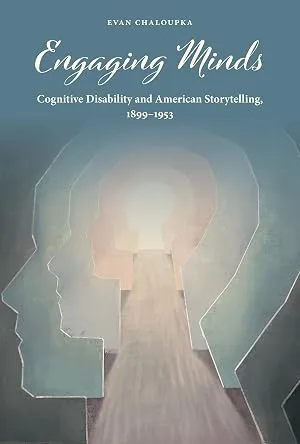
Engaging Minds: Cognitive Disability and American Storytelling, 1899–1953
Chaloupka, E. (2026). Engaging minds: Cognitive disability and American storytelling, 1899–1953. University of Tennessee Press.
Available here →October 24, 2026
20261024-chaloupka-engaging-minds-in-a-nutshell
In a nutshell
The rest of this thread

Evan Chaloupka
Evan Chaloupka is an independent scholar who has most recently served as a Fulbright Lecturer in American Studies at the Tsuda University and the University of Tokyo. His book, Engaging Minds: Cognitive Disability and American Storytelling, is available through the University of Tennessee Press. His work on disability, narrative theory, and American literature and culture has been published in Literature and Medicine, The Journal of Literary and Cultural Disability Studies, and The Journal of Narrative Theory among other venues.
Pull this thread
Fiction can bring readers close to cognitive disability without entering a character's mind.
Know something the rest of us don't?
Most threads on Rorotoko begin with our invitation. Any thread can begin with a proposal: you write it with the same prompts every thread answers, and we review it.
Propose a thread →