
Yucheng Lin
Committed Antarctic Ice Sheet mass loss by the end of the twenty-first century
Even at 1.5 °C, Antarctica loses ice this century. How much is our choice.
The question took hold of me in front of one chart. It showed the best projections the field had of Antarctica’s contribution to sea level by 2100. The lines came from ice-sheet models run by groups around the world. They fanned out like the ribs of a paper fan. Most said Antarctica would push sea level up. A few said it would pull sea level down. The spread straddled zero.
Here was the largest store of ice on the planet, and we couldn’t agree on the sign.
That disagreement is not an academic squabble. It sits underneath a very practical problem.
Roughly one in ten people on Earth lives on low-lying coastal land. In Hong Kong, where I work, that’s more than 3 million people. Across the Greater Bay Area, the ring of cities around the Pearl River Delta in southern China, it’s about 40 million. Sea walls, drainage tunnels and airports are built to last for decades. The people who design them need to know how much the sea will rise, and how fast. And the biggest unknown in those numbers is Antarctica.
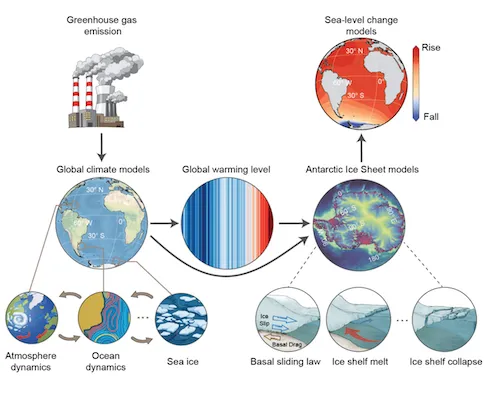
Why is Antarctica so hard to predict? Because no single model can do it. It takes a chain of them. Greenhouse gas emissions go into global climate models, which simulate how the air, the ocean and the sea ice respond. That warming is handed to ice-sheet models, which work out how fast ice shelves melt from below and how easily the ice behind them slides over bedrock. The lost ice is then handed to models of sea level itself. Each step feeds the next, and every handoff adds a little blur. Scientists call it cascading uncertainty. By the end of the chain, the blur was wide enough to swallow the sign.
The obvious fix is more simulations. But each run picks one set of assumptions at every link, and each run can occupy a supercomputer for days. No team can afford to try every plausible combination.
In the Ice Sheet Model Intercomparison Project, groups around the world ran their models under shared rules and pooled the results into a large archive. But it couldn’t easily answer one question: which of these futures fit what Antarctica has already done?
Those two questions became our project. The team brought together data scientists, glaciologists and oceanographers. We stopped treating the archive as a set of forecasts to average and started treating it as something to learn from. We trained an AI model on it.
This model is what scientists call an emulator: a fast stand-in that learns how each simulation’s outcome depends on the assumptions built into it. How easily does ice slide over the rock beneath it? How readily does an ice shelf melt when the water around it warms? Once trained, the emulator does in a fraction of a second what the original models needed days to do.
That speed changed what we could ask. We ran millions of combinations of assumptions, then checked hundreds of thousands of possible futures against what Antarctica has actually done. Since 2002, twin satellites have been weighing the ice sheet from space by sensing tiny changes in Earth’s gravity. Futures that didn’t match that record were cut.
The survivors gave a clear answer: Antarctica loses ice this century, even at 1.5 °C.
Ongoing thread. More from Yucheng Lin to follow.
The chain of models used to project Antarctica’s future, from greenhouse gas emissions to sea-level change. Every handoff adds uncertainty. © Yucheng Lin
Curator: Bora Pajo
Committed Antarctic Ice Sheet mass loss by the end of the twenty-first century
Lin, Y., Zhang, X., Golledge, N. R., Kopp, R. E., Church, J. A., Jin, Y., Zhao, C., … Stokes, C. R. (2026). Committed Antarctic Ice Sheet mass loss by the end of the twenty-first century. Nature Geoscience. https://doi.org/10.1038/s41561-026-02102-1
Available here →October 22, 2026
20261022-lin-committed-antarctic-ice-sheet-mass-loss-by-the-end-of-the-twenty-first-century-the-wide-angle
The wide angle
The rest of this thread

© Yucheng Lin
Yucheng Lin
Yucheng Lin is an assistant professor in the School of Energy and Environment at City University of Hong Kong. He earned his PhD in physical geography at Durham University, then worked as a postdoctoral researcher at Rutgers University and a research scientist at CSIRO in Australia. His research combines geophysics, Bayesian statistics and artificial intelligence to reconstruct the past, characterize the present and project the future of sea-level change, and to quantify the risks it poses. He led the 2026 Nature Geoscience study on committed Antarctic ice loss, and a 2025 Nature study on quantifying global sea-level rise since 1900 is at least faster than any century over the past 4,000 years.
Pull this thread
Antarctica will lose ice this century even at 1.5 °C, but emissions still decide how much.
Know something the rest of us don't?
Most threads on Rorotoko begin with our invitation. Any thread can begin with a proposal: you write it with the same prompts every thread answers, and we review it.
Propose a thread →