
Isla C. Duporge
Quantifying the control laws governing terminal attack in lions
In the last seconds of a chase, lions rely on steering more than speed.
The filming took place at Lion Country Safari in Florida, starting at about half past eight in the morning, before the park opened. The drone went up first and held position at more than seventy metres, which is high enough that the lions did not react to it. A lure attached to a motorised pull box was set out in the grass, and a gate was opened to let a lioness out.
Each chase lasted about sixteen seconds. Watching from the ground, it is difficult to see anything more than the lure moving through the grass and the lion closing on it. The movements that decide the outcome happen too quickly to follow by eye. That was the problem I wanted to solve: how to measure what the lion does, stride by stride, during those seconds.
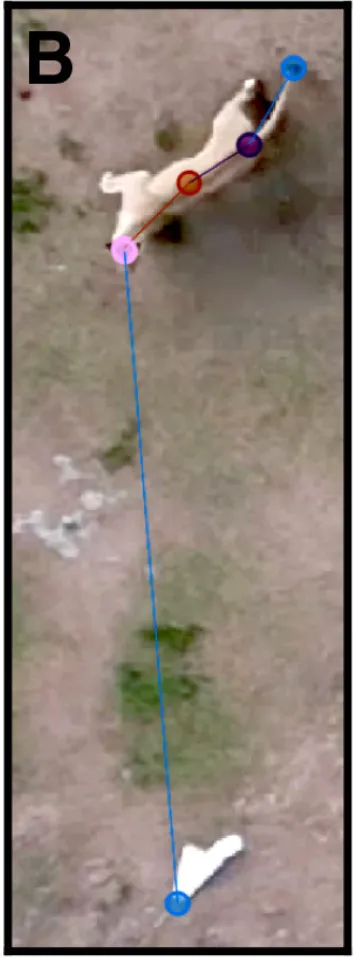
Lions are among the most studied large carnivores, and decades of fieldwork have described how they hunt as a group. Observers have identified roles within a pride hunt: "wings", which circle around the prey, and "centres", which wait for prey to be driven toward them. What had not been measured is how an individual lion converts the movement of its prey into its own steering and speed during the chase itself. This is hard to do in the wild. Lions range over large areas, hunt mostly at night and attack without warning. GPS collars with motion sensors can record a lion's speed and turning, with some error in position, but they record nothing about the prey. A chase involves two moving bodies, and the pursuer's behaviour cannot be understood without the target's track.
In the meantime, biologists working on other species had borrowed the mathematics of missile guidance to describe how animals intercept moving targets. Guidance laws had been fitted to peregrine falcons, dragonflies, bats, predatory flies, tiger beetles, honeybees and Harris's hawks. These are all small animals, and most of them fly. No large mammal running on the ground had been tested.
The tools needed to do this are recent. Consumer drones can now record video at 5.4K resolution from a height that does not disturb the animal. Pose-estimation software, which tracks points on an animal's body across thousands of video frames, can then extract the animal's position in each frame. I used SLEAP, a program developed at Princeton. To convert positions in the video into distances on the ground, I surveyed fixed landmarks in the enclosure, such as poles, fence posts and trees, with GPS and matched them to the same features in the footage.
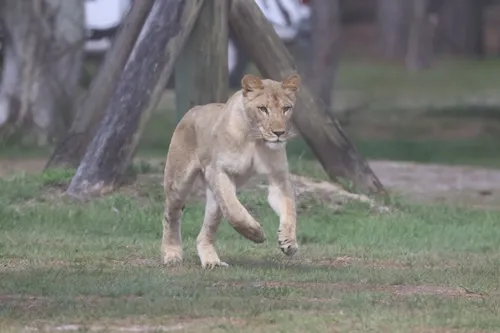
The lure provided the other half of the data. Motorised boxes pulled a cone along fourteen different routes so that the lions could not learn a course, and a meat reward was placed at the end. The keepers were willing to run it because the chases served as enrichment, and the lions needed very little encouragement.
Over four months I recorded 67 chases. That left me with a large set of trajectories and a question about control that I was not equipped to answer alone. I contacted Hadleigh Frost, a theoretical physicist at the Institute for Advanced Study who works on the mathematics of particle collisions, and asked whether he would look at the data. The collaboration that followed produced the paper and we had great fun working together.
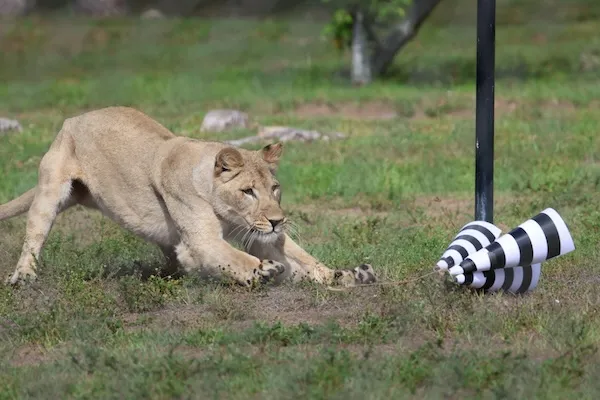
© Alex Frias
Curator: Bora Pajo
Quantifying the control laws governing terminal attack in lions
Duporge, I., & Frost, H. (2026). Quantifying the control laws governing terminal attack in lions. Current Biology. https://doi.org/10.1016/j.cub.2026.09.018
Available here →October 20, 2026
20261020-duporge-terminal-attack-in-lions-the-wide-angle
The wide angle
The rest of this thread

© Collete Duporge
Isla C. Duporge
Isla Duporge is an Associate Research Scholar in the Department of Ecology and Evolutionary Biology and the Lewis-Sigler Institute for Integrative Genomics at Princeton University. She uses AI-based detections from image data (earth-observation satellites and drones) to study animal movement patterns, with a focus on gregarious migratory species. Her study of lion pursuit appeared in Current Biology in 2026 (https://doi.org/10.1016/j.cub.2026.09.018).
Pull this thread
In the last seconds of a chase, lions rely on steering more than speed.
Know something the rest of us don't?
Most threads on Rorotoko begin with our invitation. Any thread can begin with a proposal: you write it with the same prompts every thread answers, and we review it.
Propose a thread →