
Pamela Foohey
Forgive Us Our Debts: How Black Churches Use Bankruptcy to Survive
When it filed bankruptcy in June 2020, the Cathedral of the Holy Spirit was known as Prayer Tabernacle Church of Love. Bishop Kenneth Moales Sr. founded the church in Bridgeport, Connecticut, in the early 1970s. At its height, the congregation numbered close to a thousand members. I spoke with Pastor Kenneth Moales Jr., Bishop Moales's son, about eighteen months after Prayer Tabernacle filed bankruptcy.
Although the church did not have any millionaire congregants, as described by Pastor Moales, it had “strong blue-collar low-middle-class” members eager to see the church succeed. As its congregation grew, Prayer Tabernacle needed to expand. To build a ministry center that could seat fifteen hundred people, as desired by the congregation, Prayer Tabernacle needed a loan. And it would have to build from scratch because there was nothing in Bridgeport sufficiently large to convert into what Bishop Moales and church members contemplated.
Bishop Moales and Pastor Moales approached five different banks for a loan. They estimated that the church needed $6 million. That estimate reflected the size of the proposed building, which needed space to include the church's day care and school. It also reflected real property values and the construction costs in Connecticut. All five banks turned them away, including the local bank with which the church had done business for thirty-five years.
Only then did Prayer Tabernacle hook up with a prominent Christian-based lender—Foundational Capital Resources (FCR). FCR provided Prayer Tabernacle with a more than sufficient loan and even helped it with construction plans. At first, FCR did not talk finances. It talked faith and vision. Still, the loan FCR sold to Prayer Tabernacle came with a seemingly high interest rate and onerous terms. Terms that the church rather quickly could not meet.
Prayer Tabernacle scrambled. It completed construction of its new sanctuary, barely. But Prayer Tabernacle's finances were left in shambles. And after a decade of precarious worship in a building constantly under threat of being taken away, a state court judge ordered Prayer Tabernacle's eviction for failure to pay FCR. At that point, the church owed much more to FCR than its original loan amount. This prompted Prayer Tabernacle's bankruptcy filing.
Prayer Tabernacle's journey to bankruptcy court, and then through the reorganization process, is one of seven churches' stories profiled in Forgive Us Our Debts—six Black churches and one white church. These seven churches' stories link the United States' long history of predatory lending to Black churches' predominance in bankruptcy courts. At its core, Forgive Us Our Debts is about lending to Black-owned businesses. And it is a study of Black communities' fighting back against attempts to extract wealth.
Curator: Bora Pajo
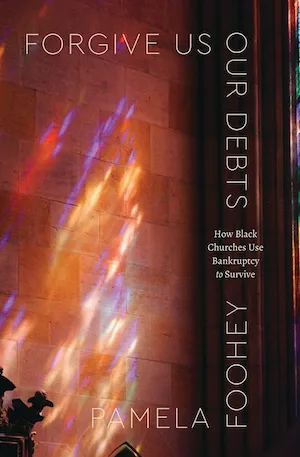
Forgive Us Our Debts: How Black Churches Use Bankruptcy to Survive
Foohey, P. (2026). Forgive us our debts: How Black churches use bankruptcy to survive. University of Chicago Press.
Available here →October 19, 2026
20261019-foohey-forgive-us-our-debts-how-black-churches-use-bankruptcy-to-survive-a-close-up
A close-up
The rest of this thread

Pamela Foohey
Pamela Foohey is the Curtis Bradbury Kellar Professor of Law at the University of Minnesota. She is a researcher and teacher of the laws about bankruptcy, business, debt, and credit, and how they affect people and communities. Most of her work involves empirical studies of bankruptcy and related parts of the legal system. In addition to Forgive Us Our Debts: How Black Churches Use Bankruptcy to Survive, she is the co-author of Debt's Grip: Risk and Consumer Bankruptcy, which draws on data from the people who file bankruptcy to tell the story of financial struggle in the United States.
Pull this thread
Black churches file over 60 percent of church bankruptcies, and nothing on the church's side explains it.
Know something the rest of us don't?
Most threads on Rorotoko begin with our invitation. Any thread can begin with a proposal: you write it with the same prompts every thread answers, and we review it.
Propose a thread →