
Kiara Wyndham
Diversityland: Hiding Racial Inequality in an American Suburb
Several important conversations are happening about suburbia today: the housing crisis, environmental sustainability, the concentration of affluence, and political polarization. My work enters a conversation that receives less attention, in part because we often picture suburbia as a white place: racial equity.
When Americans think about racial inequality, they often picture cities or perhaps remote rural communities. Our imaginations are behind reality: suburbs are home to the majority of Black, Latinx, Asian, white, immigrant, and poor Americans. Some suburbs remain deeply segregated, but many are becoming more diverse. The racial realities of twenty-first-century America are increasingly being lived out in suburbs, yet we spend far less time talking about racial inequality and equity there.
I am a white person who grew up in the suburbs. So, it is not surprising that when I took my first sociology class in college, I realized how deeply ignorant I was of the realities of racism in America. What made this surprising was that I did not grow up in a mostly white suburb, but rather in one of the most diverse communities in America. Much white ignorance operates through isolation. But I wasn’t isolated. This disconnect nagged at me through the rest of college and into graduate school. I wanted to understand why something felt off in my home community.
As a graduate student, I returned to Fort Bend to investigate. I discovered a local racial ideology that functions as a social contract that I call the diversity contract. The diversity contract helped explain my disconnect, as one of the terms of the contract is that it forbids discussions of racism and inequality. Living amid diversity had not taught me to see racial inequality. Instead, the community’s rules had helped make it invisible. My research traces how this happens and how the diversity contract can obscure even clear evidence of racial inequality. Fort Bend shows that a common equation – diversity equals equity – is false.
Zooming out, Fort Bend raises important questions about a longstanding hope among researchers and policymakers: that racial residential integration – people from different racial groups living in the same communities – will help reduce racial inequality.
I theorize that the diversity contract enables sustained integration – racial diversity that persists over time – because its rules help maintain peace and protect residents’ economic investments in the community. But this bargain requires something valuable enough to protect.
Affluent suburbs offer highly rated schools, valuable homes, amenities, and social status. If this argument is right, sustained integration should be concentrated in affluent suburbs. My national analysis finds exactly that. If we are waiting for integration alone to solve America’s racial problems, then we will be waiting a long time. Integration may be valuable, but proximity alone cannot dismantle inequality. That requires confronting how power, opportunity, and resources are distributed within diverse communities.
Ongoing thread. More from Kiara Wyndham to follow.
Curator: Bora Pajo
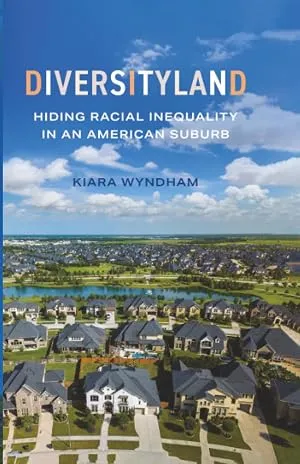
Diversityland: Hiding Racial Inequality in an American Suburb
Wyndham, K. (2026). Diversityland: Hiding racial inequality in an American suburb. University of California Press.
Available here →October 16, 2026
20261016-wyndham-diversityland-the-wide-angle
The wide angle
The rest of this thread

© Taylor Brown
Kiara Wyndham
Kiara Wyndham is an assistant professor of sociology at Washington University in St. Louis.
They study how American suburbs produce and sustain racial and class inequality. Their book, Diversityland, examines how local racial ideologies can maintain racial inequality amid racial diversity, while their broader research investigates how suburban institutions and policies shape segregation and inequality. They currently direct the St. Louis Zoning Atlas, which examines how local zoning contributes to racial and class segregation across the St. Louis region.
Pull this thread
Fort Bend County's celebrated racial harmony rests on a bargain to praise the diversity and never name the inequality.
Know something the rest of us don't?
Most threads on Rorotoko begin with our invitation. Any thread can begin with a proposal: you write it with the same prompts every thread answers, and we review it.
Propose a thread →