
Ronald H. Fritze
Invented Knowledge
I first became interested in pseudo-history during the late 1980s when I was a faculty member at Lamar University. The five hundredth anniversary of Columbus’s first voyage to the Americas was coming up. I decided to offer a special topics course on Columbus. While preparing for that course, I began to come across various theories about people who discovered or settled the Americas before 1492.
Of course, the ancestors of the Native Americans got here many thousands of years before Columbus and the Norse of Greenland also had a brief sojourn in North America. But I was learning about Qin Chinese, ancient Egyptians, medieval Arabs, a wandering Pole, Templar refugees, and Atlanteans among many others. All of this information was extremely interesting, commonly discussed, and believed by people. And it was also just plain wrong.
I proposed to write a one-volume encyclopedia about the topic of pre-Columbian visitors to the Americas. Along the way I discovered there was a whole universe of other pseudo-history circulating through popular culture. It is an intriguing and sometimes scary wilderness of the intellect. I have remained interested in the phenomenon ever since and wanted to write more about it. Invented Knowledge is the result.
Ludicrous ideas about the past are common in popular culture. They have great appeal to many people. Legends that Prince Madoc and his medieval Welsh companions settled in North America and were transformed into white Indians appeal to our sense of adventure. They also appeal to the ethnic pride of Welsh-Americans. Suggesting that black people were the original and superior humans on the earth while whites are the later evil products of a perverse mad scientist helped to make life more bearable to downtrodden African Americans trapped in urban ghettos of Depression era America. Out of that milieu the Nation of Islam was born.
Fallacious ideas about the past have been the foundations for ideologies of other very violent and dangerous groups. The Nazis, for example, embraced an Aryan myth of German origins and also adopted the conspiracy theory of Jewish domination promoted by the fraudulent Protocols of the Elders of Zion. Pseudo-history has a dark side.
My book also discusses how fringe theories about the past reverberate between works of purported non-fiction and works of fiction. Science fiction and thriller novels, films, and television shows frequently incorporate pseudo-historical and pseudo-scientific ideas. These adaptations make for clever and enjoyable plots whether it is Indiana Jones, the X-Files, or a Clive Cussler novel.
Such fiction, however, can also inspire pseudo-knowledge. Jules Verne’s Twenty Thousand Leagues under the Sea began an Atlantis revival that Ignatius Donnelly solidified. H. P Lovecraft’s weird tales of impossibly ancient and monstrous super-civilizations inspired theories about ice-age civilizations in prehistoric times and visits by ancient astronauts.
The divide between non-fiction and fiction or true events and imaginative stories is usually quite clear for most people. On occasion, however, some people can have difficulty distinguishing between fact and fiction. The boundary between the two is sometimes fuzzy, and for some even non-existent. In that twilight zone of confusion, pseudo-history and pseudo-science can and does thrive.
Fringe scholars use deeply flawed methodologies. They mine their sources for evidence that backs their ideas and ignore the cases where the evidence contradicts them. Historical documents, archaeological remains, and scientific results are misinterpreted and distorted to serve the preconceived notions of writers like Immanuel Velikovsky.
The Piri Reis Map is one of the documents most frequently misinterpreted by fringe scholars. The somewhat unclear geographical features it depicts have been cited to prove the existence of ancient ice age civilizations, various pre-Columbian discoveries of the Americas, and visitations by ancient aliens.
Others purveyors of bogus knowledge like Madame Helena Blavatsky made up sources. Much of Blavatsky’s knowledge about the very distant past was allegedly derived from Akashic records transmitted to her by psychic means. Needless to say, this has made it hard for the skeptical to verify her references.
It is an interesting aspect of pseudo-scholarship and its practitioners that their ideas are often mutually exclusive. If one is true, the others generally have to be false.
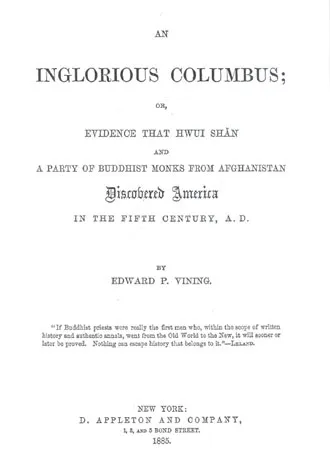
Part of the long tradition of Chinese visitors to Pre-Columbian America
Editor: Erind Pajo
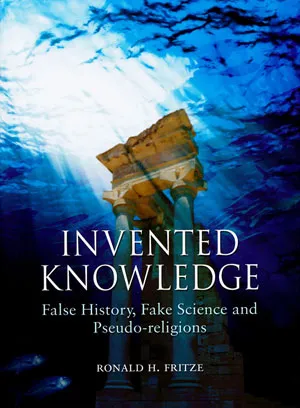
Invented Knowledge
Ronald Fritze Invented Knowledge: False History, Fake Science and Pseudo-Religions Reaktion Books 272 pages, 9 x 6 inches ISBN 978 1861894304
Available here →July 8, 2009
20090708-fritze-ronald-invented-knowledge-false-history-fake-science-pseudo-2
The wide angle
The rest of this thread

Betty Marks
Ronald H. Fritze
Ronald H. Fritze is Dean of the College of Arts and Sciences and Professor of History at Athens State University. Formerly he was on the faculty of Lamar University where he was University Professor of History. Besides Invented Knowledge he is the author of Legend and Lore of the Americas before 1491: An Encyclopedia of Visitors, Explorers, and Immigrants (1993) and New Worlds: The Great Voyages of Discovery, 1400-1600 (2002) along with a number of other books. He appeared in the History Channel series Conquest of America produced by Lone Wolf Documentary in 2005.
Pull this thread
pulls againstpulls alongside
Pseudo-history is a product of modern mass society, built from the obsolete and discredited scholarship of earlier eras.
Against RB · Innovation generates uncertainty that past data cannot turn into measurable risk, and the banks were making exactly that conversion. On: Amateurs and outsiders produce knowledge that credentialed specialists cannot
Against IH · Belzoni's achievements in Egypt have been ignored because he was a foreign circus strongman rather than a scholar. On: Amateurs and outsiders produce knowledge that credentialed specialists cannot
Alongside CC · Veblen was an academic insider par excellence, and his heterodox economics came from that position rather than from marginality. On: Amateurs and outsiders produce knowledge that credentialed specialists cannot
Alongside PE · There is no such thing as raw global climate data. On: Amateurs and outsiders produce knowledge that credentialed specialists cannot
Alongside JS · The productive unit for writing about popular music is the moment and the place, not the life. On: Amateurs and outsiders produce knowledge that credentialed specialists cannot
Alongside KM · Macaroni and cheese endures because it keeps finding new cultural work, not because it tastes good. On: Amateurs and outsiders produce knowledge that credentialed specialists cannot
Nearby PL · You cannot know a bias led you wrong without already knowing the truth, so thinking should be about process.
Nearby DV · Orientalism was canonized without being read through, and Said's own thesis is itself an essentialism.
Know something the rest of us don't?
Most threads on Rorotoko begin with our invitation. Any thread can begin with a proposal: you write it with the same prompts every thread answers, and we review it.
Propose a thread →