
Philip Goodchild
Theology of Money
While the paradigm frequently offered for understanding our society is freedom of the market, the reality of most people’s experience of economic life is one of constraint. Why is this?
It is hard to identify where ‘the market’ is, but it is simple to observe where the transfer of money takes place. We all need money, not only for buying and selling, but for the payment of taxes, rents, wages and interest.
Modern money is created by banks when money is loaned in excess of reserves. Money is essentially credit, a belief system, in which we participate in practice so long as we treat money as valuable. This means that money is also debt. Every time we handle money, we handle someone else’s debt or obligation.
Modern money is valuable because someone else is promising to pay, and they are trusted. What are they paying, and to whom? They promise to pay back the loan with interest, and pay it back in the form of money. They promise to acquire money, perhaps through investment, or labour, or the sale of assets, or speculation, to pay off their obligations. So they pay with the obligations of others.
Then modern money is not simply a belief system because we treat paper tokens or sight deposits as valuable – it is also a system of obligations. Economic life is constrained by the perpetual need for acquiring money.
This has enormous implications. Modern economics and politics—and even, to some extent, sociology—are based on the idea of human freedom. And they intend to advise us on the choices that we make. But they are ill-equipped for understanding money because transcendent obligations are put aside from the start, and confined to the sphere of ‘religion’ or ‘superstition.’
This book analyses the ‘theology of money.’ The title is ironic, for the method is philosophical. This is not an account of the history of Christian views on money.
The point is to comprehend the way in which money as a supreme value and transcendent obligation shapes the conduct of our lives and institutions. Debt has replaced God as the guarantee for human cooperation, and our modern globalised world is driven by the religion of money.
Editor: Erind Pajo
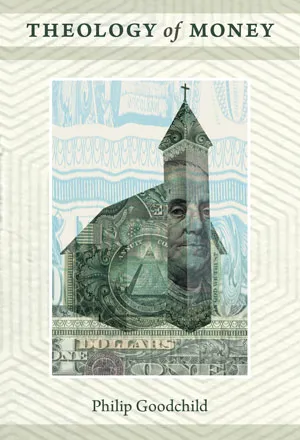
Theology of Money
Philip Goodchild Theology of Money Duke University Press 304 pages, 9 x 6 inches ISBN 978 0822344506 ISBN 978 0822344384
Available here →November 30, 2009
20091130-goodchiled-philip-on-theology-of-money-1-1
In a nutshell
The rest of this thread

Philip Goodchild
Philip Goodchild is Professor of Religion and Philosophy at the University of Nottingham in the UK. He is the author of Gilles Deleuze and the Question of Philosophy (1996), Deleuze and Guattari: An Introduction to the Politics of Desire (1996), and Capitalism and Religion: The Price of Piety (2002), as well as editor of Rethinking Philosophy of Religion (2002) and Difference in Philosophy of Religion (2003).
Pull this thread
pulls againstpulls alongside
Modern money is bank credit, therefore debt, and debt has replaced God as the guarantee of human cooperation.
Against JS · The prohibition on hosting kleptocrats' money fails for structural reasons, and the remedy is to recruit the profit motive. On: Human conduct is well modelled as self-interested calculation of costs and benefits
Against EP · States punish violators of international law badly, so they violate it with impunity when benefits exceed costs. On: Human conduct is well modelled as self-interested calculation of costs and benefits
Alongside LS · Unselfish behavior is common and switched on by social cues, so law should trigger conscience rather than price conduct. On: Human conduct is well modelled as self-interested calculation of costs and benefits
Alongside NE · People consistently underestimate how positively others will respond to being engaged, and the result is chronic undersociality. On: Human conduct is well modelled as self-interested calculation of costs and benefits
Alongside CP · The unhoused on our streets are ourselves dressed in rags, and refusing them empathy costs us dearly. On: Human conduct is well modelled as self-interested calculation of costs and benefits
Alongside JA · Capitalism is a culture, neither inevitable nor natural, so it takes a different shape in every country that adopts it. On: Human conduct is well modelled as self-interested calculation of costs and benefits
Nearby PB · Corporate support for Black culture is diversity capital, an asset the firm accumulates for itself.
Know something the rest of us don't?
Most threads on Rorotoko begin with our invitation. Any thread can begin with a proposal: you write it with the same prompts every thread answers, and we review it.
Propose a thread →