
Harriet Ritvo
Noble Cows and Hybrid Zebras
Disciplines like zoology and veterinary medicine have always taken animals seriously as the subject of research. In the humanities and social sciences, the field sometimes known as “animal studies” began to emerge in the 1980s, and it has flourished and diversified in the subsequent decades.
The essays collected in Noble Cows and Hybrid Zebras were written over this same period. They illustrate the evolution of the field, as well as my own evolution as a historian. A few of the essays deal with contemporary issues such as mad cow disease and the use of animals in laboratory experiments. Most of the essays, however, focus on British history.
Within this focus, these essays engage a wide variety of topics. For example, the noble cows of the title were (and are) a small group of white cattle with black ears, claimed by their aristocratic owner to have descended directly from the aboriginal bovine ancestors, without the intervening humiliation of domestication.
The hybrid zebras of the title were crosses with horses and ponies, produced by a Scottish zoologist at the end of the nineteenth century to disprove the widely believed theory of telegony or influence of the previous sire (the belief that the father of a female’s first child would somehow influence her subsequent offspring by different fathers).
In addition to zoology and animal husbandry, the essays in the volume also offer historical perspective on the fields of veterinary medicine, gender studies, and comparative psychology.
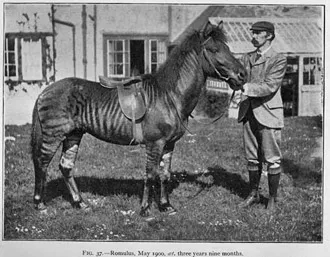
Cossar Ewart and his stud zebra. (Image courtesy of the author’s archive.)
Editor: Erind Pajo
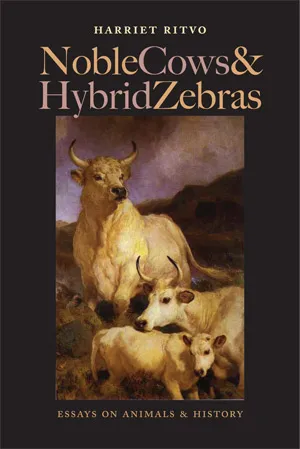
Noble Cows and Hybrid Zebras
Harriet Ritvo Noble Cows & Hybrid Zebras: Essays on Animals & History University of Virginia Press 256 pages, 6 x 9 inches ISBN 978 0813930602
Available here →July 20, 2011
20110720-ritvo-harriet-noble-cows-hybrid-zebras-animals-history-1-1
In a nutshell
The rest of this thread

Harriet Ritvo
Harriet Ritvo is the Arthur J. Conner Professor of History at the Massachusetts Institute of Technology. In addition to the books mentioned in her Rorotoko interview, she is the author of The Dawn of Green: Manchester, Thirlmere, and Modern Environmentalism and the editor of Charles Darwin’s The Variation of Animals and Plants under Domestication, and has published widely on British history, the history of human-animal relations, and environmental history. Harriet Ritvo is a past president of the American Society for Environmental History and a member of the editorial boards of journals in British history, the history of science, and animal studies.
Pull this thread
pulls againstpulls alongside
When people talk about animals they disclose their assumptions about each other.
Against CS · Turtles are as endangered as primates, and their apparent invulnerability is exactly what makes them easy to take. On: There is a nature independent of human action that environmental thought can appeal to
Against BM · De-extinction is a failure to learn what drove species extinct, and it threatens the wildness it claims to save. On: There is a nature independent of human action that environmental thought can appeal to
Alongside JI · Conservation is one of the routes by which capitalist worldviews became environmental, not a defense of nature against capitalism. On: There is a nature independent of human action that environmental thought can appeal to
Alongside CF · Environmental concern did not arrive late in France, and environmentalism has no single political valence. On: There is a nature independent of human action that environmental thought can appeal to
Alongside PW · Nature has ended, and environmentalism should welcome it, managing wildness rather than fencing it off. On: There is a nature independent of human action that environmental thought can appeal to
Alongside JK · There is no balance of nature, not now and not at any point in Earth's history. On: There is a nature independent of human action that environmental thought can appeal to
Know something the rest of us don't?
Most threads on Rorotoko begin with our invitation. Any thread can begin with a proposal: you write it with the same prompts every thread answers, and we review it.
Propose a thread →