
Committed Antarctic Ice Sheet mass loss by the end of the twenty-first century
Even at 1.5 °C, Antarctica loses ice this century. How much is our choice.
Antarctica is already committed to losing ice this century, even if the world meets the Paris Agreement’s most ambitious goal of holding warming to 1.5 °C.
That may sound obvious. It isn’t. For years, the best computer models of Antarctica could not agree on which way it would go.
Here’s why. Warming pulls Antarctica in two directions at once. A warmer ocean eats away at the ice shelves, the floating slabs of ice that fringe the continent, melting them from below. But warmer air also holds more moisture, so more snow falls on the ice sheet. In some projections, the extra snow outweighs the ice lost to the ocean, and the ice sheet actually grows.
Antarctica has long been the wild card of sea-level science. It holds enough ice to raise global sea level by about 58 meters. Yet no one has been able to say with confidence whether it will add to rising seas by 2100 or hold them back a little.
My colleagues and I now think that question has an answer. Antarctica loses. Our analysis puts the chance at 92 percent or higher. That is not certainty. Fewer than one in twelve of the futures that fit the evidence still ends with Antarctica holding more ice than it does today.
How did we get there? Previous assessments relied on running ice-sheet models, which are slow. We took a shortcut. We trained an AI on a large archive of existing simulations. Its speed let us test hundreds of thousands of possible futures against what satellites have measured since 2002. Only futures that matched the real ice sheet survived. The survivors point one way: ice loss this century, even at 1.5 °C.
Now the part that’s easy to get wrong. “Committed” doesn’t mean “too late.”
The commitment comes from the state the ice sheet is in today. It is already out of balance, and it responds to warming with a long delay. That fixes the direction of change, not its size. How much ice Antarctica loses still depends on what we emit. Every ton of greenhouse gas we avoid reduces the loss this century, and the benefit lasts for hundreds of years.
So this isn’t a story of doom. It’s a change in the question. We used to ask whether Antarctica would shrink this century. It will. The question now is by how much, and that part is still up to us.
Ongoing thread. More from Yucheng Lin to follow.

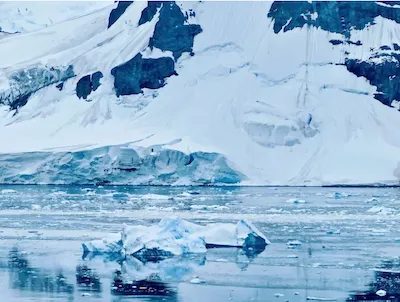
A glacier front meets the sea in Antarctica. The ice sheet holds enough ice to raise global sea level by about 58 meters. © Qiyue Sun
Agent Nation: How Autonomous AI Is Rewriting the Rules of Society—and What We Can Do About It
I've spent close to two decades studying how people look for information and how systems decide what to show them. Search, recommendation, ranking. For most of that time, the ethical questions in my field had a particular shape: what gets surfaced, what gets buried, whose perspective ends up on page one. Serious questions. But the system was still handing you options. You chose.
Somewhere around 2022 and 2023, that stopped describing what I was seeing. The systems weren't presenting options anymore. They were closing loops. Not "here are candidates you might consider," but "these are rejected, these move forward." Not "here's information about your claim," but a determination. The interesting part is that this wasn't announced. There was no launch event for the end of the human in the loop. It happened one procurement decision at a time, because someone had a backlog and the software was cheaper than three more staff.
That's the shift the book sits on top of, and it makes a lot of the existing literature slightly off-target. Cathy O'Neil's work on algorithmic bias, which I admire, diagnoses flawed models producing unfair outcomes. Still true. But a biased model is a static object you can audit. An agent adapts, acts in sequence, and produces consequences that nobody specified in advance. Mustafa Suleyman writes about containing powerful future technology. Verity Harding argues for public participation in setting AI's direction. Both matter. Both are aimed slightly downstream of where I think the pressure is. The agents already deployed in ordinary bureaucratic settings are doing more to reshape people's lives right now than anything in a frontier lab.
What pushed me from "this is a research interest" to "this is a book" was watching who gets caught in the gap. I've spent time with judges, federal agencies, and people building these systems inside companies. What struck me was that almost nobody in those rooms was acting in bad faith. The engineers thought the policy people were handling oversight. The policy people assumed the technical controls covered it. The vendors pointed at their clients. The clients pointed at the vendor.
And in the middle of that polite circle of deferral is a person who got denied something and can't find out why.
I don't think you fix that with better models. Better models are coming regardless. You fix it by building institutions that can answer a simple question on demand: who decided this, and how do I contest it. We have a long history of doing exactly that for other powerful systems. We just haven't done it here yet.
Ongoing thread. More from Chirag Shah to follow.
This week's threads
All the threads →



Istanbul Exchanges
Know something the rest of us don't?
Most threads on Rorotoko begin with our invitation. Any thread can begin with a proposal: you write it with the same prompts every thread answers, and we review it.
Propose a thread →