
Rooming House
I didn’t write this about the world, I wrote it about myself.
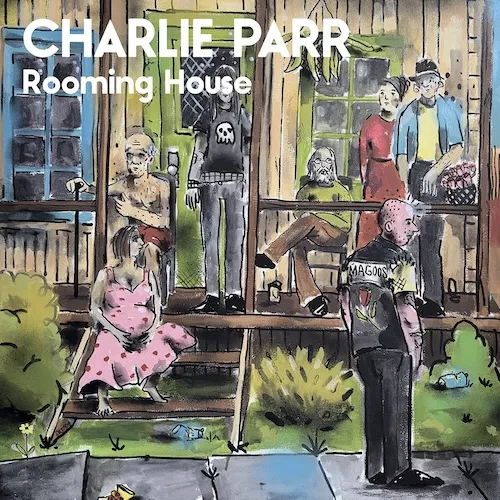
In a nutshell, this album isn’t about the world, it's only about myself and my fear about getting old and being alone and being broke and being sick. It’s a fantasy about living in a world where the word neighbor is being used as a verb, such as “we were neighboring down the road”, meaning “I helped the neighbor do their chores” or “we all had coffee at so-and-so’s house” or “so-and-so is sick and their kids have moved away so we’ll all pitch in and help them out”. It’s a fantasy about a world where empathy isn’t a bad word, where people practice gratitude rather than judgment and where patience and kindness replace anger and intolerance.
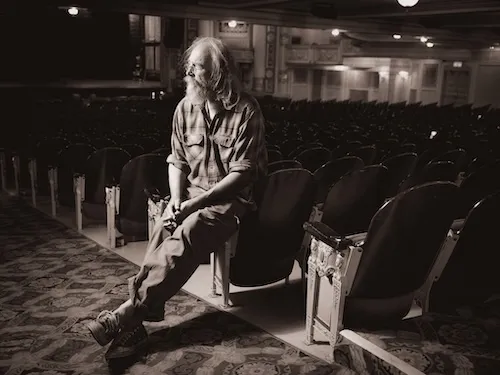
It’s a fantasy about a place where people still get sick and still die but we’re all thoughtful about what it means to be alive in the first place and we’ll cringe with grief at each passing and our grief will be shared and understood and held up as something sacred and important instead of something weak and foolish. It’s a fantasy world where money doesn’t get to decide who deserves medical attention, or enough food for a day, or adequate shelter for the night. In this world, in this kitchen, at this corner table by the window, within this small family of people who choose one another and accept responsibility for one another, each one gets a seat.
Rooming House Album
Committed Antarctic Ice Sheet mass loss by the end of the twenty-first century
Even at 1.5 °C, Antarctica loses ice this century. How much is our choice.
The question took hold of me in front of one chart. It showed the best projections the field had of Antarctica’s contribution to sea level by 2100. The lines came from ice-sheet models run by groups around the world. They fanned out like the ribs of a paper fan. Most said Antarctica would push sea level up. A few said it would pull sea level down. The spread straddled zero.
Here was the largest store of ice on the planet, and we couldn’t agree on the sign.
That disagreement is not an academic squabble. It sits underneath a very practical problem.
Roughly one in ten people on Earth lives on low-lying coastal land. In Hong Kong, where I work, that’s more than 3 million people. Across the Greater Bay Area, the ring of cities around the Pearl River Delta in southern China, it’s about 40 million. Sea walls, drainage tunnels and airports are built to last for decades. The people who design them need to know how much the sea will rise, and how fast. And the biggest unknown in those numbers is Antarctica.
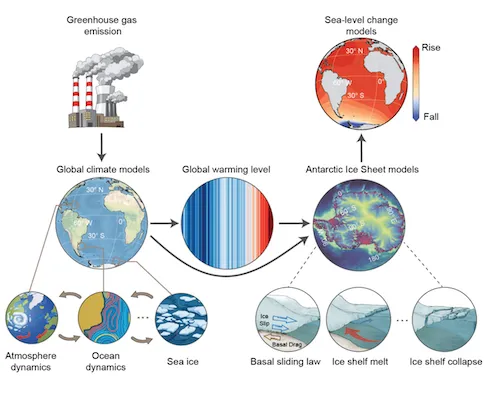
Why is Antarctica so hard to predict? Because no single model can do it. It takes a chain of them. Greenhouse gas emissions go into global climate models, which simulate how the air, the ocean and the sea ice respond. That warming is handed to ice-sheet models, which work out how fast ice shelves melt from below and how easily the ice behind them slides over bedrock. The lost ice is then handed to models of sea level itself. Each step feeds the next, and every handoff adds a little blur. Scientists call it cascading uncertainty. By the end of the chain, the blur was wide enough to swallow the sign.
The obvious fix is more simulations. But each run picks one set of assumptions at every link, and each run can occupy a supercomputer for days. No team can afford to try every plausible combination.
In the Ice Sheet Model Intercomparison Project, groups around the world ran their models under shared rules and pooled the results into a large archive. But it couldn’t easily answer one question: which of these futures fit what Antarctica has already done?
Those two questions became our project. The team brought together data scientists, glaciologists and oceanographers. We stopped treating the archive as a set of forecasts to average and started treating it as something to learn from. We trained an AI model on it.
This model is what scientists call an emulator: a fast stand-in that learns how each simulation’s outcome depends on the assumptions built into it. How easily does ice slide over the rock beneath it? How readily does an ice shelf melt when the water around it warms? Once trained, the emulator does in a fraction of a second what the original models needed days to do.
That speed changed what we could ask. We ran millions of combinations of assumptions, then checked hundreds of thousands of possible futures against what Antarctica has actually done. Since 2002, twin satellites have been weighing the ice sheet from space by sensing tiny changes in Earth’s gravity. Futures that didn’t match that record were cut.
The survivors gave a clear answer: Antarctica loses ice this century, even at 1.5 °C.
Ongoing thread. More from Yucheng Lin to follow.

The chain of models used to project Antarctica’s future, from greenhouse gas emissions to sea-level change. Every handoff adds uncertainty. © Yucheng Lin
Old in the Game: Aging in and with Hip-Hop
Like many people living outside of New York City in 1979, my first exposure to hip-hop came via the radio with the rap track “Rapper’s Delight” by the Sugarhill Gang. It was fun and interesting, but lacking contextual knowledge about the early, percolating hip-hop scene, I didn’t think it would amount to more than an innovative confection, a mere flash-in-the-pan. But I kept an ear and an eye on the emerging scene and by the time “The Message,” by Grandmaster Flash and the Furious Five was released in 1982, it was obvious that not only did rap have depth that I had initially missed, but it seemed to me to have staying power. I saw how hip-hop’s creative elements — DJing, MCing/rapping, B-Boying/breaking, and graffiti — were insurgent, inciteful and insightful, inflecting urban space, altering the sonic environment and changing the visual landscape. And they were fun.
As a late-night campus-community radio DJ and a freelance journalist working the culture beat in a major Canadian city in 1984-85, I had entrée to several urban micro-scenes. My involvement in the local reggae scene offered easy access to the clubs and parties — small, tight, smoky, bass-heavy spaces. It was there that I noticed that, in the breaks between the band or DJ sets, the music increasingly included rap tracks, usually featuring Jamaican “riddims” and lyrical “toasting,” but also often foregrounding booming New York hip-hop. Young Black folks gathered in these clubs and it was clear that hip-hop was an important and growing facet of their everyday lives. It was soon impossible to adequately comprehend Black youth, and eventually young people in general, without having some knowledge of the hip-hop scene.
By the late-1980s, it also dawned on me that many of the top hip-hop artists whose music, art and dance I found so compelling were my age or younger, having started their careers in their mid-teens and early twenties. At the time, this surprised me. At its inception, hip-hop culture really was made by Black and Latino youth for their youthful peers, with adults pushed to the periphery. But as tends to happen — barring death — hip-hop’s pioneers, founders, and subsequent generations matured, aging in and with hip-hop. And as most of the founders will admit, they weren’t trying to build a culture in the 1970s and early 1980s; they didn’t foresee a lifetime of being tagged as hip-hop pioneers. They were simply young folks out to have fun in ways that were unprecedented, without maps or guardrails.
Hip-hop itself was my guide in this project. I let the culture enunciate its age-oriented predilections, articulating the concerns and fears, anger and resentment, or joy and pleasure that accompany the expression of age identities. Along with my personal interviews, hip-hop magazines, as well as coverage in the mainstream press, provided a deep archive of interviews, reviews, and social commentary that revealed different phases of hip-hop’s age awareness. Bio-pics and film documentaries were key textual sources. Rap lyrics also offer a trove of lyrical gems encompassing age issues, whether this involves expressing age-based self-loathing (such as a lament about one’s decline into “old flow”), “beef” and “battles” (age-oriented jousting to undermine and insult “opps” and competitors), or nostalgic reminiscences about earlier and ostensibly more innocent times.
Ongoing thread. More from Murray Forman to follow.

© Matthew Modoono
This week's threads
All the threads →




The Story of Silver
Know something the rest of us don't?
Most threads on Rorotoko begin with our invitation. Any thread can begin with a proposal: you write it with the same prompts every thread answers, and we review it.
Propose a thread →